

Spotlight
Top Categories
Featured





The Hidden Risk of Reducing Security Alert Noise: Are You Silencing the Threats That Matter?
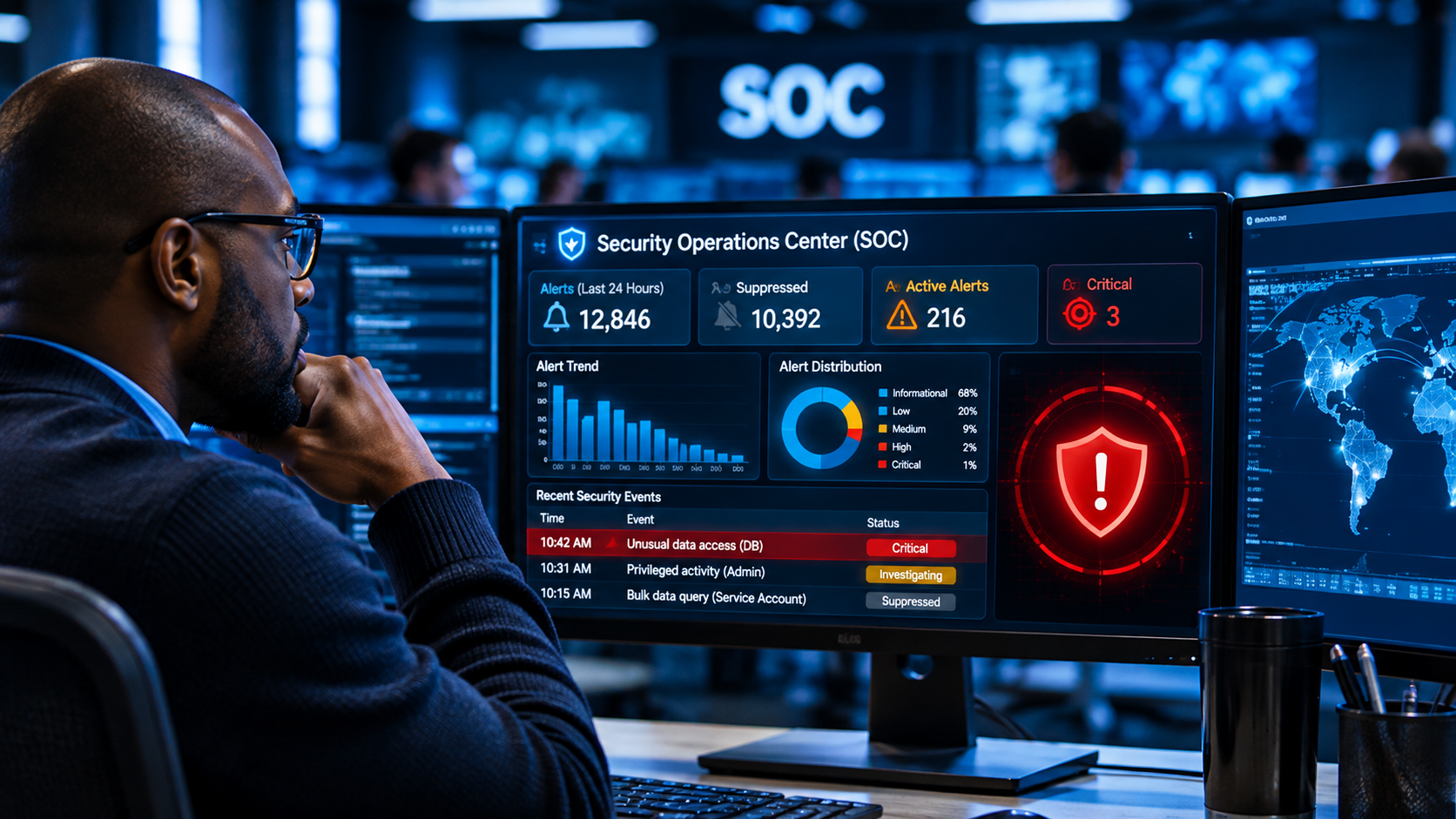
How enterprises can balance threat visibility, detection accuracy, and SOC automation without compromising security.
By Ervin Daniels, CISSP, CCSP, CBCP
Introduction: When Fewer Alerts Don’t Necessarily Mean Better Security
Every cybersecurity leader wants a quieter Security Operations Center (SOC).
Fewer false positives. Less time spent investigating routine activity. More attention devoted to the threats that genuinely matter.
But what if reducing security alerts also means reducing your organization’s ability to detect an attack?
This is one of the more challenging realities of modern cybersecurity operations.
Enterprises invest heavily in security technologies designed to identify suspicious behavior across networks, applications, databases, cloud platforms, and identities. Yet those same technologies can generate thousands of alerts, many tied to legitimate business activity.
Over time, security teams face a difficult decision: continue investigating overwhelming volumes of alerts or adjust detection capabilities to make the workload manageable.
Sometimes, that adjustment involves disabling certain detection rules, suppressing alerts, or excluding specific activities from monitoring.
While these actions may provide immediate operational relief, they can also introduce unintended security gaps.
The real objective should never be to generate fewer alerts. It should be to generate more meaningful alerts while maintaining the visibility necessary to identify genuine threats.
Achieving that balance requires a deliberate approach to threat detection, behavioral analytics, security policy tuning, and SOC integration.
1. The Alert Fatigue Problem: When Security Tools Become Too Noisy
Modern enterprises operate increasingly complex technology environments.
A single organization may have thousands of databases, cloud workloads, applications, service accounts, privileged users, and automated processes interacting with sensitive information every day.
Security monitoring technologies observe these activities and attempt to identify behaviors that may indicate unauthorized access, misuse, or malicious intent.
The challenge is that legitimate business activity can sometimes resemble suspicious behavior.
Consider a few common examples:
- A database administrator runs an unusually large number of queries during scheduled maintenance.
- A service account accesses sensitive records as part of an automated business process.
- A monitoring application repeatedly queries database metadata to assess system performance.
- An authorized employee accesses information outside their typical usage pattern because of a new assignment.
- A development or testing process generates SQL statements that resemble known attack patterns.
Depending on the detection logic, these activities may trigger security alerts even when no malicious activity has occurred.
For SOC analysts, every alert requires some level of attention. They must determine what happened, identify the user or process involved, review supporting evidence, and decide whether the activity warrants further investigation.
When too many alerts prove harmless, analysts can experience alert fatigue.
This creates several operational risks: longer investigation times, slower incident response, reduced analyst productivity, and the possibility that genuinely malicious activity becomes harder to spot among routine notifications.
The temptation is understandable: reduce alert volume so the team can focus on more important work.
However, reducing alert volume and improving security effectiveness are not the same.
2. The Hidden Cost of Disabling Threat Detection
Imagine an enterprise security team responsible for monitoring sensitive database activity.
Its database security platform generates repeated alerts for unusual data access, administrative activity, and changes to database structures.
After investigating numerous alerts and determining that most are legitimate, the team decides to turn off several noisy detection rules.
Almost immediately, the number of alerts decreases.
SOC analysts spend less time investigating routine activities. Operational dashboards look cleaner. Security teams may even report improved alert management.
But an important question remains:
Did the organization improve its security posture, or did it simply stop looking for certain types of suspicious activity?
Turning off a detection capability does not eliminate the underlying threat.
It may only eliminate the organization’s ability to recognize or report that threat through the affected control.
For example, turning off a noisy privileged-access detection could reduce false positives while also making certain forms of unauthorized administrative activity harder to identify.
Similarly, suppressing unusual data-access alerts may reduce operational workload but also limit visibility into potential insider threats or compromised accounts.
This does not mean organizations should never disable detection rules.
Legitimate reasons include retiring ineffective controls, removing redundant detections, or temporarily turning off a rule while investigating its behavior.
The key is understanding the consequences.
Before turning off a detection capability, security teams should answer four questions:
- What specific threat or behavior is this control intended to detect?
- Why is it generating excessive or inaccurate alerts?
- What detection coverage will be lost if it is disabled?
- Does another control provide equivalent visibility?
These questions shift the conversation from alert reduction to risk management.
A well-managed security program should be able to explain not only which detections are enabled, but also which are disabled, why they were disabled, and how it addresses the associated risks.
3. Why Legitimate Activity Can Look Like a Cyberattack
One of the fundamental challenges of threat detection is distinguishing unusual behavior from malicious behavior.
The two are not always the same.
Traditional security detection often relies on predefined rules, patterns, signatures, and thresholds.
For example, a rule might generate an alert when a user executes a particular SQL statement, accesses a sensitive database object, or performs an administrative action outside an expected timeframe.
These methods are valuable because they provide a consistent way to identify known behaviors of concern.
However, they may lack sufficient context.
A database administrator accessing hundreds of records during an approved maintenance window may be performing a legitimate task.
The same activity performed by a compromised account at an unusual time could indicate a serious security incident.
The technical action may look similar, but the business context is very different.
This is why effective detection requires more than recognizing an individual event.
Security teams need to understand the relationship between identity, activity, systems, timing, authorization, and normal business operations.
The role of behavioral analytics
Behavioral analytics can help address this challenge by establishing patterns of normal activity and identifying meaningful deviations.
Instead of evaluating only whether an activity matches a predefined rule, behavioral detection can consider questions such as:
- Is this activity unusual for the account?
- Has the user accessed this database before?
- Is the volume of data access significantly different from historical patterns?
- Does the activity occur at an unexpected time?
- Is the behavior consistent with the account’s intended purpose?
Machine learning and statistical analysis can help identify deviations that traditional rules might miss.
However, behavioral analytics introduces its own challenges.
An unusual activity is not automatically malicious. Business processes change, users assume new responsibilities, and automated workloads can produce legitimate spikes in activity.
Therefore, behavioral analytics still requires validation, tuning, and business context.
Artificial intelligence and machine learning can improve threat detection, but they do not eliminate the need for human judgment.
The strongest detection strategies combine multiple techniques rather than relying exclusively on signatures, rules, or behavioral models.
4. Security Policy Tuning: Reduce Noise Without Creating Blind Spots
Effective security monitoring is not a one-time configuration exercise.
It is an ongoing operational process that must evolve alongside the enterprise environment.
As applications change, databases are migrated, service accounts are introduced, and business processes evolve, security detection policies must be reviewed and adjusted.
A well-designed tuning strategy should reduce unnecessary alerts without broadly suppressing important activity.
Start with the source of the noise.
Before changing a detection rule, determine why it is generating alerts.
Is the activity associated with a trusted monitoring application? Is a service account performing an expected automated task? Is the detection threshold too sensitive for the environment?
Understanding the source allows teams to make targeted adjustments rather than turning off an entire detection category.
Use narrow, context-aware exclusions.
Exclusions can be valuable when used carefully.
For example, a security team may determine that a specific monitoring application performs predictable database metadata queries that repeatedly trigger alerts.
Rather than turning off all monitoring for database structure changes, the team could consider an exclusion limited to the approved application identity, expected activity, and authorized environment.
This approach can reduce noise while preserving visibility into similar activity performed by unauthorized users or processes.
Document exclusions, review them periodically, and limit them to the smallest practical scope.
Tune thresholds using operational evidence.
Some detections rely on thresholds, such as the number of failed logins, frequency of sensitive queries, or volume of data accessed within a particular period.
Thresholds should reflect the organization’s operating environment and risk tolerance.
A threshold appropriate for a small departmental database may not suit a high-volume enterprise transaction system.
The objective is to distinguish meaningful deviations from expected operational variability.
Validate changes before broad deployment.
Where practical, organizations should test policy adjustments in controlled environments before implementing them across production systems.
However, lower environments may not accurately reproduce production traffic volumes or user behavior.
In these cases, security teams may need carefully governed production pilots, limited deployment scopes, additional monitoring, and clearly defined rollback procedures.
Every tuning change should have a measurable objective.
For example, did the adjustment reduce false positives while preserving detection of the suspicious activity the control was designed to identify?
Without that validation, fewer alerts provide little assurance that security has improved.
5. Threat Detection Is Only Half the Battle: The Importance of SOC Integration
Even the most accurate threat detection capability has limited value if the organization cannot effectively respond to what it discovers.
Security events must move from detection systems into operational workflows where analysts can evaluate, investigate, prioritize, and resolve them.
This often involves integrating specialized security platforms with Security Information and Event Management (SIEM) systems, Security Orchestration, Automation, and Response (SOAR) technologies, ticketing systems, and incident management processes.
But integration is more than simply forwarding alerts.
An effective SOC workflow should preserve the information analysts need to understand and act on a detection.
This may include the affected system, account identity, activity details, detection rationale, severity, timestamps, and supporting evidence.
Without adequate context, analysts may need to move between multiple tools to reconstruct what happened.
That additional effort can slow investigations and reduce the operational value of the detection.
Moving from alert delivery to automated workflows
APIs and automation can help organizations improve the way security cases are retrieved, enriched, assigned, and managed.
For example, an automated workflow might:
- Retrieve a newly generated security case from a detection platform.
- Enrich the case with identity, asset, and business context.
- Correlate the activity with other security events.
- Assign the case to the appropriate SOC workflow.
- Record investigation outcomes and use them to inform future tuning.
Automation can reduce repetitive tasks and improve consistency.
However, automation should not be confused with autonomous decision-making.
High-impact actions, such as disabling accounts or blocking critical database activity, require appropriate authorization, safeguards, and human oversight.
The ultimate goal is not simply to move alerts between systems faster.
It is to turn security detections into actionable intelligence that supports timely, informed decisions.
6. Five Practical Recommendations for Security Leaders
Organizations seeking to improve their security monitoring capabilities should consider five operational priorities.
1. Measure detection effectiveness, not just alert volume
A reduction in alerts is meaningful only when the organization understands what changed.
Track metrics such as false-positive rates, confirmed detection outcomes, analyst investigation time, and the proportion of important threat scenarios covered by active controls.
2. Establish a detection coverage inventory
Document which threats the organization intends to monitor, which controls support those detections, and where coverage gaps exist.
Include disabled rules, temporary exclusions, and known limitations.
This provides a more complete picture of security visibility.
3. Implement continuous policy tuning
Review noisy detections regularly with database administrators, application owners, identity teams, and SOC analysts.
Use business context to refine policies and avoid unnecessarily suppressing important activity.
4. Strengthen integration between security platforms and the SOC
Evaluate how cases are delivered, what supporting evidence is available, and where manual processes create delays.
Use APIs and orchestration where appropriate to improve consistency and reduce repetitive work.
5. Establish a feedback loop between analysts and detection engineers
SOC investigations provide valuable information about which alerts are useful, which are misleading, and which detections require improvement.
That feedback should directly inform policy tuning, analytics configuration, and detection engineering priorities.
The result is a continuous improvement cycle in which operational experience strengthens detection effectiveness over time.
7. The Bigger Picture: AI, Automation, and the Future of Security Operations
As enterprises adopt artificial intelligence, cloud-native architectures, and increasingly autonomous applications, security monitoring will become even more complex.
AI-powered applications and agents may interact with sensitive data, invoke APIs, access enterprise systems, and execute tasks with varying levels of autonomy.
These activities introduce new challenges for security teams attempting to distinguish authorized behavior from misuse.
Traditional rules will remain important, but organizations will increasingly need contextual detection capabilities that understand identities, permissions, data sensitivity, application behavior, and business intent.
AI-assisted analytics may help security teams identify patterns, correlate events, and prioritize investigations.
Yet the same fundamental principle will continue to apply:
Detection quality matters more than detection quantity.
A sophisticated AI-driven security platform that generates thousands of irrelevant alerts can still create operational challenges.
Likewise, an aggressively tuned system that suppresses meaningful signals can leave an organization exposed.
The future of effective security operations will depend on balancing intelligent analytics, automation, strong governance, and human expertise.
Organizations that achieve this balance will be better positioned to identify genuine threats without overwhelming the teams responsible for responding.
Don’t Confuse a Quiet SOC with a Secure Enterprise
Security leaders should welcome improvements that reduce unnecessary alerts and make their teams more effective.
But they should also recognize that a quieter security environment is not necessarily a safer one.
When organizations turn off detections, make exclusions too broad, or tune security policies without understanding their impact, they may unintentionally sacrifice visibility for operational convenience.
The better approach is to treat alert management as an ongoing discipline that connects threat detection, business context, policy tuning, and SOC operations.
Security teams should continually ask whether they are identifying the right threats, giving analysts useful information, and preserving the monitoring capabilities needed to protect critical enterprise assets.
Ultimately, an effective security program is measured not by how few alerts it generates.
It’s whether the organization can recognize and respond to the threats that truly matter.
About the Author
Ervin Daniels, CISSP, CCSP, CBCP, is a cybersecurity and data security professional with experience in enterprise security architecture, security operations, risk management, and technical advisory services. His work focuses on helping organizations strengthen data protection, improve security operations, and navigate emerging challenges involving cloud security, artificial intelligence, and enterprise governance.
The views expressed in this article are the author’s own and are intended for educational and thought-leadership purposes. Any scenarios discussed are illustrative and do not represent or disclose a specific organization’s security environment.

Previous post

200
insert_link
share
close
A Comprehensive Framework for Managing AI Risk
Designing an AI Governance + AI Security Framework Artificial intelligence is rapidly becoming embedded across the enterprise from data collection and model training to deployment, runtime usage, autonomous agents, and [...]

Post comments (0)